Complete text edition (all 40 pages)
1 / 40MOTOWN MISSILE / CHALLENGER
THE COMPLETE COLLECTOR BOOK
FROM THE MOON TO THE RACETRACK.
COMPLETE COLLECTOR EDITION 2.0 / OCTOBER 2026
01
FROM THE MOON
TO THE RACETRACK.
BUILT TO RACE. BUILT TO ADVANCE.
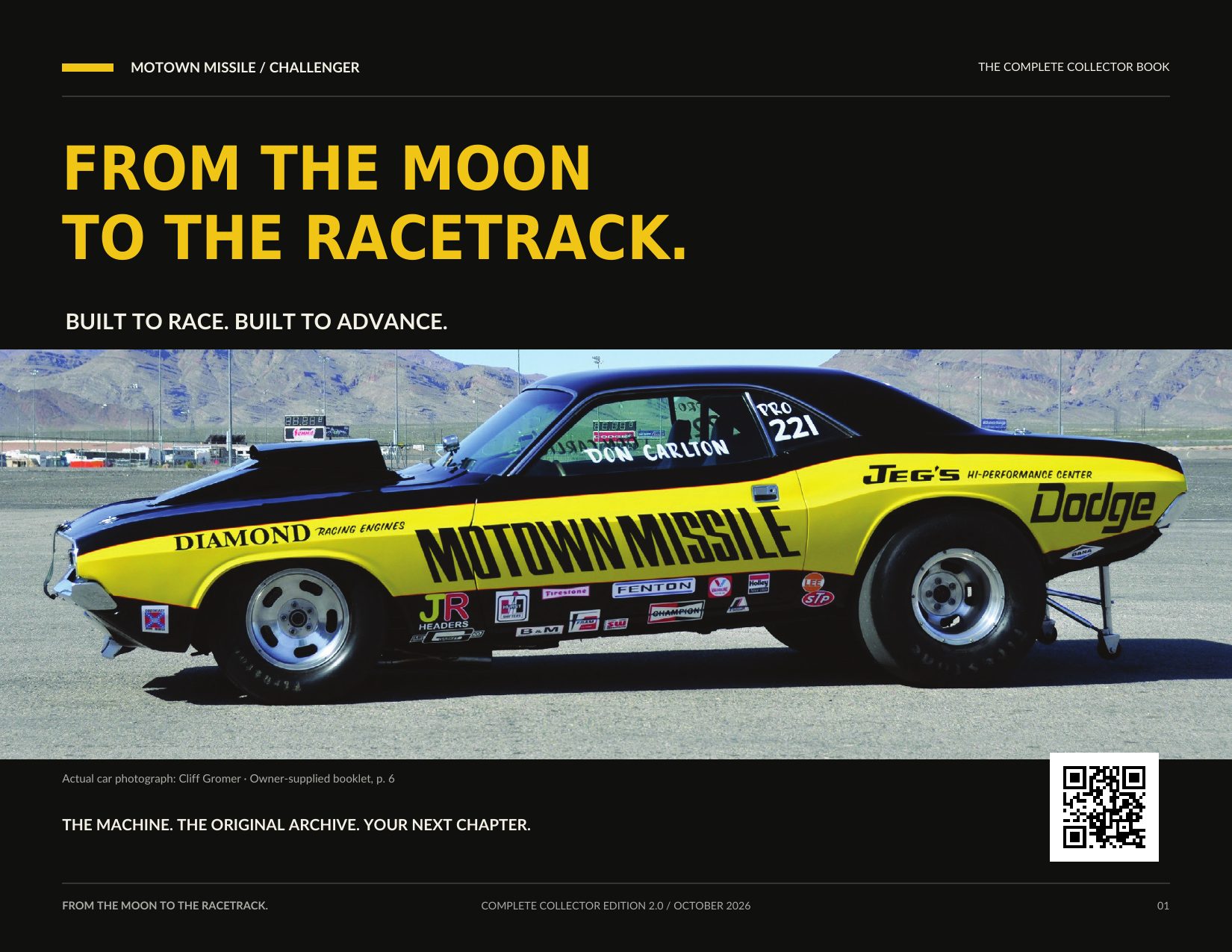
Actual car photograph: Cliff Gromer · Owner-supplied booklet, p. 6
THE MACHINE. THE ORIGINAL ARCHIVE. YOUR NEXT CHAPTER.
2 / 40MOTOWN MISSILE / CHALLENGER
AN INVITATION
FROM THE MOON TO THE RACETRACK.
COMPLETE COLLECTOR EDITION 2.0 / OCTOBER 2026
02
A LETTER TO
THE NEXT CUSTODIAN.
To the collectors, advisers and auction specialists who see more than a machine,
The black body and yellow billboards make the first impression. The people and
engineering give you a reason to stay. This Challenger’s story reaches beyond the
finish line to the work of testing what came next.
From the Moon to the Racetrack introduces a real connection: Chrysler’s aerospace
chapter, expertise that moved into its racing effort, and a factory-backed development
car built for the demands of Pro Stock.
This complete edition keeps the original owner booklet intact, then connects it with
the current story, the Vision Film, and the practical path to a private conversation. Its
QR codes take you to the permanent website for the latest material.
Look closely. Follow the sources. Bring the questions that matter to you.
Trunk artwork: Greg of Akron · Owner booklet, p. 21
The Motown Missile Project Team
Felipe & Jeralin Soares
Prepared for Arnie Klann
3 / 40MOTOWN MISSILE / CHALLENGER
YOUR READING ROUTE
FROM THE MOON TO THE RACETRACK.
COMPLETE COLLECTOR EDITION 2.0 / OCTOBER 2026
03
TAKE THE LONG LOOK.
One complete book. The original account. A clear path into the current story.
02–06
THE INVITATION & CONNECTION
The actual car, the aerospace connection and the
development mission.
07–31
THE COMPLETE OWNER ARCHIVE
All 25 original booklet pages, in their supplied
order.
32–35
ENGINEERING, PEOPLE & FILM
Influence beyond one team, the trunk artwork and
collector briefing.
36–40
YOUR NEXT CHAPTER
QR resource desk, specialist dialogue, collector
access and source notes.
READ ONLINE OR KEEP THIS PDF
Every QR code also has a clickable destination. Historical archive pages retain their original voice; new editorial pages use the current campaign copy.
4 / 40MOTOWN MISSILE / CHALLENGER
THE MOON-TO-RACETRACK CONNECTION
FROM THE MOON TO THE RACETRACK.
COMPLETE COLLECTOR EDITION 2.0 / OCTOBER 2026
04
WHAT DOES THE MOON
HAVE TO DO WITH PRO STOCK?
01 / THE CORPORATE CHAPTER
CHRYSLER & APOLLO
Chrysler’s Space Division developed and built the first stage of
Saturn IB, used in early Apollo missions. That is the precise
aerospace chapter behind the campaign—not a claim that
Chrysler built the entire Saturn V.
02 / THE HUMAN CONNECTION
EXPERTISE WENT RACING
Ron Killen’s firsthand seminar account traces aerospace
electronics work in Huntsville and subsequent work in Chrysler
racing. People and engineering knowledge connect these
worlds; the claim is not Apollo-flown hardware in this car.
Sources: Stellantis corporate history, 22 July 2019; Second Pro Stock Missile Seminar, Ron Killen account. Full links on p. 39.
EXPLORE THE CONNECTION
motownmissile.com/engineering
THE TRACK WAS THE PROVING GROUND.
The Challenger made the development mission tangible: a car in which
ideas could be tried, evaluated and refined.
5 / 40MOTOWN MISSILE / CHALLENGER
BUILT TO RACE. BUILT TO ADVANCE.
FROM THE MOON TO THE RACETRACK.
COMPLETE COLLECTOR EDITION 2.0 / OCTOBER 2026
05
MORE THAN A
HORSEPOWER HEADLINE.
Engine photo: Motown Missile Racing · Booklet p. 14
MATERIALS
Lightening work and titanium suspension hardware are part of the owner’s
development account.
POWER
A dual-plug 426 HEMI, specialized ignition and induction, and a deliberate
engine-development program.
CHASSIS & LAUNCH
Weight transfer, suspension settings and aerodynamic refinements belonged to the
same engineering mission.
MEET THE ACTUAL CHALLENGER
motownmissile.com/the-car
Owner-supplied Proof 10, pp. 7–11, 14. Historical descriptions; current configuration requires inspection.
6 / 40MOTOWN MISSILE / CHALLENGER
ENTER THE ORIGINAL ARCHIVE
FROM THE MOON TO THE RACETRACK.
COMPLETE COLLECTOR EDITION 2.0 / OCTOBER 2026
06
OPEN
THE MISSILE FILES.
25
ORIGINAL PAGES. ORIGINAL ORDER.
The next 25 pages reproduce the owner-supplied PROOF 10 —
Motown Missile — Booklet Design as an intact source archive.
Photograph: Cliff Gromer · Booklet p. 6
HOW TO READ THE ARCHIVE
Its historical descriptions, superlatives, identifiers and original contacts remain as supplied—not newly certified by this edition. Use the
current website for active contacts and sale status. Independent identity, condition and document review remain essential.
7 / 40 · ORIGINAL BOOKLET P. 1Chrysler’s Iconic WeaponChrysler’s Iconic Weapon
Winning The Pro Stock WarsWinning The Pro Stock Wars
MOTOWN MISSILEMOTOWN MISSILE
8 / 40 · ORIGINAL BOOKLET P. 2Image-only page. See the page image or PDF.
9 / 40 · ORIGINAL BOOKLET P. 3Opportunity To Own A Legend!
Provenance:
After 35 years, this icon is now available for sale.
Owning the original Motown Missile Dodge Pro Stock
Challenger means possessing the centerpiece of a
motorsports revolution. A transformative artifact
of racing history, it represents a quantum leap
in technology and stands as a lasting symbol of
MOPAR’s racing dominance during the golden
age of muscle-car engineering and performance
excellence. A rare, original survivor—an authentic
time capsule from racing’s most influential era.
An extraordinary opportunity to steward a true
legend.
1. Historical Significance:
The Motown Missile was instrumental in Chrysler’s domination of the Pro Stock
class. Developed by Chrysler’s Special Vehicle Engineering Team, it served as a
rolling testbed for breakthrough ideas and became a cornerstone of MOPAR’s
racing success.
2. Innovation:
Under the leadership of Tom Hoover, the Motown Missile pioneered a disciplined,
data-driven engineering approach that transformed Pro Stock racing. Its
advanced data acquisition and performance analysis redefined how race cars
were developed, evaluated, and managed—an influence that extended across
motorsports, from Formula 1 to grassroots racing.
3. Racing Legacy - Proven Performance:
Capable of mid 9-second quarter-mile runs at over 151 mph, the Motown Missile
delivered performance that exceeded its contemporaries, earning international
recognition and a decisive competitive edge.
4. Winning Pedigree:
With victories, runner-up finishes, and semi-final appearances in NHRA and
AHRA Pro Stock competition, the Motown Missile was a key factor in the
success of Chrysler’s factory-backed race programs.
5. Originality:
Intentionally preserved with its battle-worn patina, this rare original survivor
bears the authentic scars of a thousand launches. Restored with historical
integrity rather than cosmetic perfection, it remains a powerful, evocative
presence that resonates deeply with fans and racers alike.
Photo: DOC
10 / 40 · ORIGINAL BOOKLET P. 4Once the centerpiece of Chrysler’s racing revolution, this late-1971–configuration Dodge Challenger stands restored as
a remarkably rare actual survivor—a true time capsule from the golden age of Pro Stock racing. Built by Ted Spehar
and his expert team with Chrysler’s Special Vehicles Division engineers from a factory 1970 HEMI 4-speed Challenger.
It served as the factory’s Pro Stock development platform. Driven, tested, and raced under the most advanced and
innovative engineering program of its era, it has been preserved with exceptional historical integrity.
Motown Missile Highlights:
- Presented in correct 1971 livery
- Lightweight, acid-dipped body-in-white shell (approximately 350 lbs removed)
- Legendary 426 dual-plug HEMI incorporating cutting-edge 1970s racing technology
- Authentic race car patina retained
- Retains its non-registered VIN (JS23ROB242444)
—a badge of purpose
A Proven Warrior, a rolling testament to Chrysler’s Pro Stock performance engineering.
Dodge Pro Stock Challenger
1970 / 1971
MOTOWN MISSILEMOTOWN MISSILE
Photo: DOC
11 / 40 · ORIGINAL BOOKLET P. 5The Motown Missile Pro Stock Challenger holds a revered place in drag racing history as a pioneering force that defined Pro Stock performance in the
early days of the NHRA class. Developed by Chrysler’s Special Vehicle Engineering Team, it was more than a race car—it was a catalyst for change.
By harnessing Chrysler’s corporate engineering resources, including its Space Division to harness its NASA-derived data acquisition technology, the
Motown Missile became the first race car built using empirical data and disciplined engineering to achieve previously unattainable performance---one
quarter-mile at a time.
More than a race car,
the dawn of a new technology age in racing!
The Motown Missile was more The Motown Missile was more
than a race car, it wasthan a race car, it was
a disruptive change agenta disruptive change agent
for all motorsports.for all motorsports.
“
Photo courtesy:
The Dick Oldfield Collection
(DOC)
12 / 40 · ORIGINAL BOOKLET P. 6Advanced chassis engineering
Advanced chassis engineering
Groundbreaking engine development
Space-age materials
Conceived and championed by Tom Hoover, the visionary behind the iconic 426 HEMI, the Motown Missile was more than a Pro Stock car; it was a
revolution on wheels. Built by Ted Spehar and his expert team, and piloted by legendary drivers Dick Oldfield and Don Carlton, the Motown Missile fused
data acquisition technology, advanced chassis engineering, space-age materials, and groundbreaking engine development into a single, dominant
force. Together, they reshaped the NHRA’s and AHRA’s emerging Pro Stock class and defined the future of drag racing and motorsports in general.
Photos courtesy of: Cliff Gromer
(CGC)
13 / 40 · ORIGINAL BOOKLET P. 7Dodge Pro Stock Challenger
• 426 Dual Plug HEMI. Block number 30
• Capacitive Discharge Ignition custom built by Ron Killen
using magnetic crank triggers to split timing advances
and timing curve for dual distributor operation.
• Mullens ported heads and Hilborn dual drive distributor
system
• High-flow Ramcharger oiling system w/custom swing
pickup (non-G force sensitive)
• Custom Tunnel Ram intake manifold by Mullens with Holley
1050 CFM carbs, modified and tuned by John Bauman
• Machine lightened block (~45Ibs removed)
• All the knowledge of the race engineers and race hardened
team experience was employed on these precision built
beasts.
• Factory body-in-white, acid dipped (~350lbs weight
reduction)
• Chemically milled panels and components to optimize
racing weight and balance.
• First use of titanium suspension parts
ENGINE
BODY AND CHASSIS
MOTOWN MISSILEMOTOWN MISSILE
14 / 40 · ORIGINAL BOOKLET P. 8Built from a 1970 Dodge HEMl 4 speed
donor car, taken straight from the final
assembly line, transferred under its
MSO, to Ted Spehar’s shop to build the
new race car that resulted in the forging
of the donor car with the lightened body
shell into the completed technology
platform racecar that rocked the Pro
Stock racing world!
Combined build has non-registered
VIN: JS23ROB242444, mounted on the
dash pad.
• Transmission: Aluminum A-833
4-speed with Hurst in-line shifter
• Dana 60 rear end modified, including
a 5:38 gear ratio.
ORIGINS & VIN
DRIVETRAIN
Photo Courtesy Of Cliff Gromer
15 / 40 · ORIGINAL BOOKLET P. 9The Innovations
The Motown Missile pioneered the first real-time data logging
system ever used in a race car. Utilizing data recorders adapted
from Chrysler Space Division—developed for NASA—the system
captured a comprehensive array of engine and vehicle performance
parameters during competition.
Recorded data included engine RPM, throttle position, longitudinal
acceleration (G-forces), driveshaft RPM, wheel speed, oil and
fuel pressure, ignition timing, transmission oil pressure (when
applicable), and additional channels as required. Data was printed
out on a strip chart recorder in a dedicated “Data Van,” where it
was corrected for atmospheric conditions using a weather station
that was in the van.
This first-of-its-kind system enabled true scientific analysis of
traction, shift points, engine load, acceleration, clutch slip, and
parasitic losses—capabilities far beyond those of contemporary
competitors. The Motown Missile established the foundation and
standard for modern motorsports data acquisition, directly
influencing the digital systems now universal across all forms of
racing.
Surviving documentation includes strip-chart recordings
and between-round data tables used to implement real-time
performance changes.
From Ted Spehar’s papers is this written register of what was recorded during
one of the early 1971 tests at Irwindale. Using the new 5.38 gearset, seven areas
wre recorded with the results from eight runs shown in the lower area. The best
time was a 9.631 at 143.08 mph using an 8,000-rpm launch.
(Photo Ted Spear ; Courtesy Steve Atwell) (From Chrysler’s Motown Missile
book, Geoff Skunkhead)
DATA ACQUISITION - NASA
EXAMPLE OF DATA RECORDED BY THE SYSTEM
16 / 40 · ORIGINAL BOOKLET P. 10The 6-speed B&M transmission was basically a standard
A727 TorqueFlite transmission with a 2 speed version bolted
behind it. The use of additional gears would help keep the
engine in it’s optimal power band.
The prototype 6-speed was developed when the Missile was
coming together in the spring of 1970.
(Photos Courtesy of Tom Hoover Family)
The shifters in the car were parallel and required skill to
master. Even Mr. Hoover was still giving Dick Oldfield credit
for his efforts in 2014 in knowing which one to shift.
Powertrain Development: Experimental Six-Speed Transmission
The development of an experimental automatic 6-speed transmission was one of many innovative concepts developed and
tested. It was clutch launched, manually shifted, but used modified automatic transmissions that were married together. The
idea was to provide gear splits that kept the engine RPM near it peak torque curve.
17 / 40 · ORIGINAL BOOKLET P. 11Suspension geometry was meticulously optimized to
enhance weight transfer and maximize traction under
launch conditions. Adjustable wheelie bar configurations
and precisely tuned shock settings and placements were
developed to achieve consistent, efficient launches and
superior straight-line performance. Titanium strut rods and
hardware was developed to lighten the front end.
CHASSIS ENGINEERING
Advanced aerodynamic refinements to the front fascia with
splitters and smoothing, hood scoop, removal of parasitic
drag appurtenances from body, enhanced high-speed stability
and contributed to lower elapsed times. The hood scoop
design was optimized to improve boundary layer bleed-off
and increase inertial supercharging of airflow.
Aerospace-grade materials were used to reduce front-end
weight, significantly Improving traction through rapid weight
transfer at launch.
AERODYNAMIC DEVELOPMENT
Photos: (DOC)
18 / 40 · ORIGINAL BOOKLET P. 12Image-only page. See the page image or PDF.
19 / 40 · ORIGINAL BOOKLET P. 13Photo Courtesy Of Dick Oldfield
20 / 40 · ORIGINAL BOOKLET P. 14The goals for the engine development program was
to develop new technology, parts and components
to make the 426 HEMI engine accelerate faster with
more horsepower and torque.
1) Refine Helmholtz resonator science for intake
manifolds
2) Reduce polar moment of inertia of rotating assembly
3) Reduce frictional and parasitic loss
4) Increase compression to enhance thermal efficiency
5) Weight reduction methodologies to reduce total
weight of engine
6) Ignition system optimization with CD technology,
spark plug radial location, external crank triggering,
and other applications of untested, new technologies
7) Optimization of carburation for various air densities
and mass flow rates
Innovative Pro Stock Engine Development
Photo: Motown Missile Racing
21 / 40 · ORIGINAL BOOKLET P. 15Dodge Pro Stock Challenger
MOTOWN MISSILEMOTOWN MISSILE
Photos courtesy of Motown Missile Racing
22 / 40 · ORIGINAL BOOKLET P. 16Chrysler’s Skunk Works
Relive Mopar’s Skunkworks racing team and its rise to
dominance in this fascinating history! The drama of 1970s
Chrysler Pro Stock drag racing unfolds in this book,
which focuses on the racing and technological evolution
of the legendary Motown Missile and Mopar Missile
racing programs from 1970 to 1977. Unequaled by any
other drag racing development program, this was a huge
undertaking in term of time, money, and effort that resulted
in changing all forms of racing’s approach to winning.
The 1970s saw great change in auto racing, with Pro Stock
being a huge draw for fans. Chrysler racing historian,
Geoff Stunkard, presents a chronological recollection,
drawing from many interviews and summaries of the
actual technical efforts that the factory accomplished and
includes both rare/unpublished technical and personal
images from the team members and some of the most
dramatic images taken by the sport’s best photographers.
The narrative is a detailed look at the team’s inner workings,
programs, victories, and even defeats. From the Challenger
and ‘Cuda to the Dusters and Colts, the book showcases the
cars that made Chrysler so much a part of this racing era.
23 / 40 · ORIGINAL BOOKLET P. 17Original Cockpit
Photos Courtesy Of Cliff Gromer
24 / 40 · ORIGINAL BOOKLET P. 18Photo Courtesy Of Cliff Gromer
25 / 40 · ORIGINAL BOOKLET P. 19Mopar Hall of Fame Induction Ceremony of the Motown Missile Team on July 9, 2016.
From L -R: Don Carlton, Jr., Al Adam, Len Bartush, Tom Coddington, Ted Spehar, Dick Oldfield,
Mike Koran, Ron Killen, Joe Pappas, and Ann Bauman (representing her father, John Bauman)
Photo: Joe Pappas
26 / 40 · ORIGINAL BOOKLET P. 20In racing history, Ted Spehar owner and chief engine developer of the Motown Missile Team, and his team of craftsmen
and engineers are remembered as technical innovators and strategic pioneers sheparded by Mr. Hoover. They emphasized
data-driven tuning and development at a time when many teams still relied on trial and error.
Their work helped establish the blueprint for how modern Pro Stock teams operate with rigorous engineering, precise
testing and an obsessive focus on performance. The Motown Missile’s influence can still be seen in the professionalism
and precision of todays NHRA Pro Stock competition.
The front valance is signed by the Motown Missile Men -
Testimony to their pride and honor to accomplish the imposible
Photo: Motown Missile Racing
27 / 40 · ORIGINAL BOOKLET P. 21Original art by “Greg of Akron”
28 / 40 · ORIGINAL BOOKLET P. 22Notable Recognitions
• NHRA Motorsports Museum (Pomona, CA): Featured in the museum’s collection as a landmark Pro Stock vehicle.
• Petersen Automotive Museum (Los Angeles, CA): Included in a two-year exhibit honoring Innovation in Drag Racing.
Only Pro Stock car exhibited.
• East Coast Drag Times Hall of Fame - Driver and the Motown Missile Team were inducted.
• SEMA Show / Mopar Alley Representative: Selected by Dodge to represent factory heritage at the SEMA Show.
• Concours d’ Elegance of America at the Inn of St. John’s - First in Class.
• Articles written in many national and international automotive magazines from Superstock and Drag Illustrated in 1971
to Dodge Garage in 2024.
At The Petersen Museum
29 / 40 · ORIGINAL BOOKLET P. 23Top Racing Achievements
• Factory Directed Chrysler Pro Stock Program: The first factory-engineered effort in NHRA Pro Stock, utilizing corporate strategic
and synergistic divisions to develop the fastest car and providing performance knowledge, data, engineering directives for
performance and parts to the Factory sponsored marketing race teams. They set the standard for engineering and performance-
driven drag racing teams.
• First car to use NASA developed Data Acquisition in Pro Stock: Pioneered the use of military/space grade components to
scientifically tune optimum performance-a major breakthrough in the racing venues of the time.
• Quickest and Fastest Pro Stock Car: The Motown Missile held the distinction of being routinely the quickest and fastest Pro Stock
car in the country able to run low ET’s and top speed on an as needed basis.
• Influential in NHRA Rules Evolution: The team’s technical and performance dominance, past down to the factory sponsored team
cars, allowed them to run quicker in comparison to their competitors on a consistent basis. This led NHRA to work diligently
reviewing and adjusting Pro Stock regulations. to slow the Chrysler cars down by adding significant weight to the cars. This
mentality eventually made Chrysler Cars uncompetitive in the class even to this day.
30 / 40 · ORIGINAL BOOKLET P. 24Image-only page. See the page image or PDF.
31 / 40 · ORIGINAL BOOKLET P. 25Serious Interested Parties, contact:
Photo Courtesy Of James Maxwell
Website: motownmissileprostockchallenger.com
E-mail: Arnold@motownmissileprostockchallenger.com
Cell: 702-370-8015
32 / 40MOTOWN MISSILE / CHALLENGER
COMPETITIVE INFLUENCE
FROM THE MOON TO THE RACETRACK.
COMPLETE COLLECTOR EDITION 2.0 / OCTOBER 2026
32
THE ADVANTAGE DID NOT
STOP AT ONE CAR.
The stopwatch measured a run.
The engineering effort reached further.
Period reporting describes the Challenger as an engineering test bed whose
useful findings went to other Chrysler racing teams. That development role
belongs beside the racing record—not beneath it.
The January 1972 account also discusses a later ’Cuda. This edition keeps the
Challenger’s history distinct from the specifications and achievements of later
program cars.
Signed panel: Motown Missile Racing · Booklet p. 20
FOLLOW THE RECORD
motownmissile.com/provenance
Source: John Dianna / Bob D’Olivo, “The New Motown Missile,” January 1972, HOT ROD republication.
33 / 40MOTOWN MISSILE / CHALLENGER
THE HUMAN RECORD
FROM THE MOON TO THE RACETRACK.
COMPLETE COLLECTOR EDITION 2.0 / OCTOBER 2026
33
THE PEOPLE
BEHIND THE MISSILE.
TOM HOOVER
Conceived and championed the program in the owner’s account.
TED SPEHAR & TEAM
Built and developed the Challenger with Chrysler engineering
involvement.
DICK OLDFIELD & DON CARLTON
The drivers named in the owner booklet’s Challenger narrative.
RON KILLEN
Specialized ignition work and the firsthand aerospace-to-racing
connection.
Motown Missile Racing · Owner booklet p. 20
LOOK CLOSER
motownmissile.com/gallery
Sources: owner-supplied booklet, pp. 6–7, 19–20; Ron Killen seminar account. Signature identification remains subject to review.
34 / 40MOTOWN MISSILE / CHALLENGER
THE ARTWORK. THE VISION FILM.
FROM THE MOON TO THE RACETRACK.
COMPLETE COLLECTOR EDITION 2.0 / OCTOBER 2026
34
HEY STARMAN—
WANNA RACE?
Artwork: Greg of Akron · Owner booklet p. 21
The car carries its own space story. Its trunk artwork shows an
elongated Motown Missile craft streaking through a celestial
scene.
That real painting inspired the Vision Film’s final transformation
and ascent. The same craft travels right/up-right, reaches space
and delivers the closing challenge.
From the Moon to the Racetrack.
The 105-second film returns to the actual Challenger and its next
custodian.
WATCH WITH SOUND
motownmissile.com/vision-film
Vision Film · Cinematic interpretation. The craft, astronaut and space scenes are fictional storytelling,
not historical footage.
35 / 40MOTOWN MISSILE / CHALLENGER
THE COLLECTOR BRIEFING
FROM THE MOON TO THE RACETRACK.
COMPLETE COLLECTOR EDITION 2.0 / OCTOBER 2026
35
THE STORY IS THE INVITATION.
THE CAR IS THE OPPORTUNITY.
Actual car: Cliff Gromer · Owner booklet p. 6
LOOK
Explore the car and the engineering account.
ASK
Request the source records that matter to your
collection.
REVIEW
Separate the historical narrative from current
inspection and written sale inclusions.
READ THE BRIEFING
motownmissile.com/collector-briefing
RACING HISTORY. YOUR NEXT CHAPTER.
36 / 40MOTOWN MISSILE / CHALLENGER
YOUR DIGITAL RESOURCE DESK
FROM THE MOON TO THE RACETRACK.
COMPLETE COLLECTOR EDITION 2.0 / OCTOBER 2026
36
SCAN. EXPLORE.
KEEP THE STORY MOVING.
THE ACTUAL CAR
Identity, configuration and
photographs.
motownmissile.com/the-car
THE MISSILE FILES
Original booklet and source
reading.
motownmissile.com/the-missile-files
THE ENGINEERING
Materials, power, chassis
and launch.
motownmissile.com/engineering
CURRENT CUSTODIAN
Coming soon. Video
uploaded when available.
motownmissile.com/#current-custodian
PRIVATE VIEWING
Discuss a closer look with
the team.
motownmissile.com/private-viewing
SALE STATUS
Consult the current official
details.
motownmissile.com/auction-details
37 / 40MOTOWN MISSILE / CHALLENGER
TO THE AUCTION SPECIALIST
FROM THE MOON TO THE RACETRACK.
COMPLETE COLLECTOR EDITION 2.0 / OCTOBER 2026
37
MAKE THE CASE
FOR YOUR STAGE.
A serious conversation about representation starts with the actual car, its record and the collectors who will appreciate its
development legacy.
THE AUDIENCE
Relevant historic-racing and Mopar relationships, supported by a
focused collector and adviser outreach plan.
THE PRESENTATION
A clear catalogue story, source review, appropriate inspection and
a faithful presentation of the black-and-yellow Challenger.
THE PROCESS
Proposed format, viewing arrangements, official participation
requirements and orderly settlement.
THE COMMERCIAL CASE
Written commissions, seller obligations, exclusivity, reserve
approach and clearly documented inclusions.
CONTACT THE PROJECT TEAM
motownmissile.com/press
Private auction targeted for Q1 2027 — tentative.
Partner, official date and final terms remain to be confirmed.
38 / 40MOTOWN MISSILE / CHALLENGER
THE NEXT CUSTODIAN
FROM THE MOON TO THE RACETRACK.
COMPLETE COLLECTOR EDITION 2.0 / OCTOBER 2026
38
YOUR NEXT CHAPTER
STARTS WITH A CONVERSATION.
Cockpit photograph: Cliff Gromer · Owner booklet p. 18
THE CURRENT CUSTODIAN
Arnie Klann presents the car and its story. His interview is coming
soon; the video will be uploaded once available.
THE NEXT CUSTODIAN
Begin with the briefing, request access and discuss the records or
a viewing. Final inclusions and transfer rights belong in the sale
agreement.
REQUEST COLLECTOR ACCESS
motownmissile.com/collector-access
EXPLORE THE NEXT CHAPTER
motownmissile.com/the-next-custodian
39 / 40MOTOWN MISSILE / CHALLENGER
EDITION & SOURCE NOTES
FROM THE MOON TO THE RACETRACK.
COMPLETE COLLECTOR EDITION 2.0 / OCTOBER 2026
39
A CLEAR RECORD.
A STRONGER CONVERSATION.
THE ORIGINAL BOOKLET
PROOF 10 — 25745 — Motown Missile — Booklet Design.pdf. All 25 original
pages appear on pp. 7–31, in their original order. The source archive retains
its own language, identifiers, photographs and historical contact references.
THE NEW EDITORIAL PAGES
Pages 1–6 and 32–40 carry the current Moon-to-racetrack campaign,
source-linked context and QR resource desk. Historical descriptions are not
independent authentication or current-condition certification.
THE PHOTOGRAPHS & ART
New-page imagery comes from the actual booklet: Cliff Gromer (car p. 6,
cockpit p. 18), Motown Missile Racing (engine p. 14, signed panel p. 20), Greg
of Akron (art p. 21). Original pages retain their own credits. Reproduction
rights remain source-specific.
CLICKABLE SOURCE READING
Chrysler’s Saturn IB first-stage chapter
Ron Killen — firsthand seminar account
The New Motown Missile — January 1972
NASA — Apollo 7 mission context
Corporate history, firsthand recollection and period reporting have different scopes. Their inclusion
does not imply sponsorship, NASA endorsement or Apollo-flown hardware in the car.
PHOTO CREDITS & RIGHTS
motownmissile.com/photo-rights
motownmissile1970@gmail.com
702-370-8015
40 / 40MOTOWN MISSILE / CHALLENGER
THE NEXT CHAPTER
FROM THE MOON TO THE RACETRACK.
COMPLETE COLLECTOR EDITION 2.0 / OCTOBER 2026
40
RACING HISTORY.
YOUR NEXT CHAPTER.
THE NEXT CUSTODIAN AWAITS.
Actual car photograph: Cliff Gromer · Owner booklet, p. 6
Explore the car. Follow the engineering. Start a conversation.
Private auction targeted for Q1 2027 — tentative.
Check the website for the appointed partner, official date and terms.