Complete text edition
1 / 14FROM THE MOON TO THE RACETRACK.
BUILT TO RACE. BUILT TO ADVANCE.
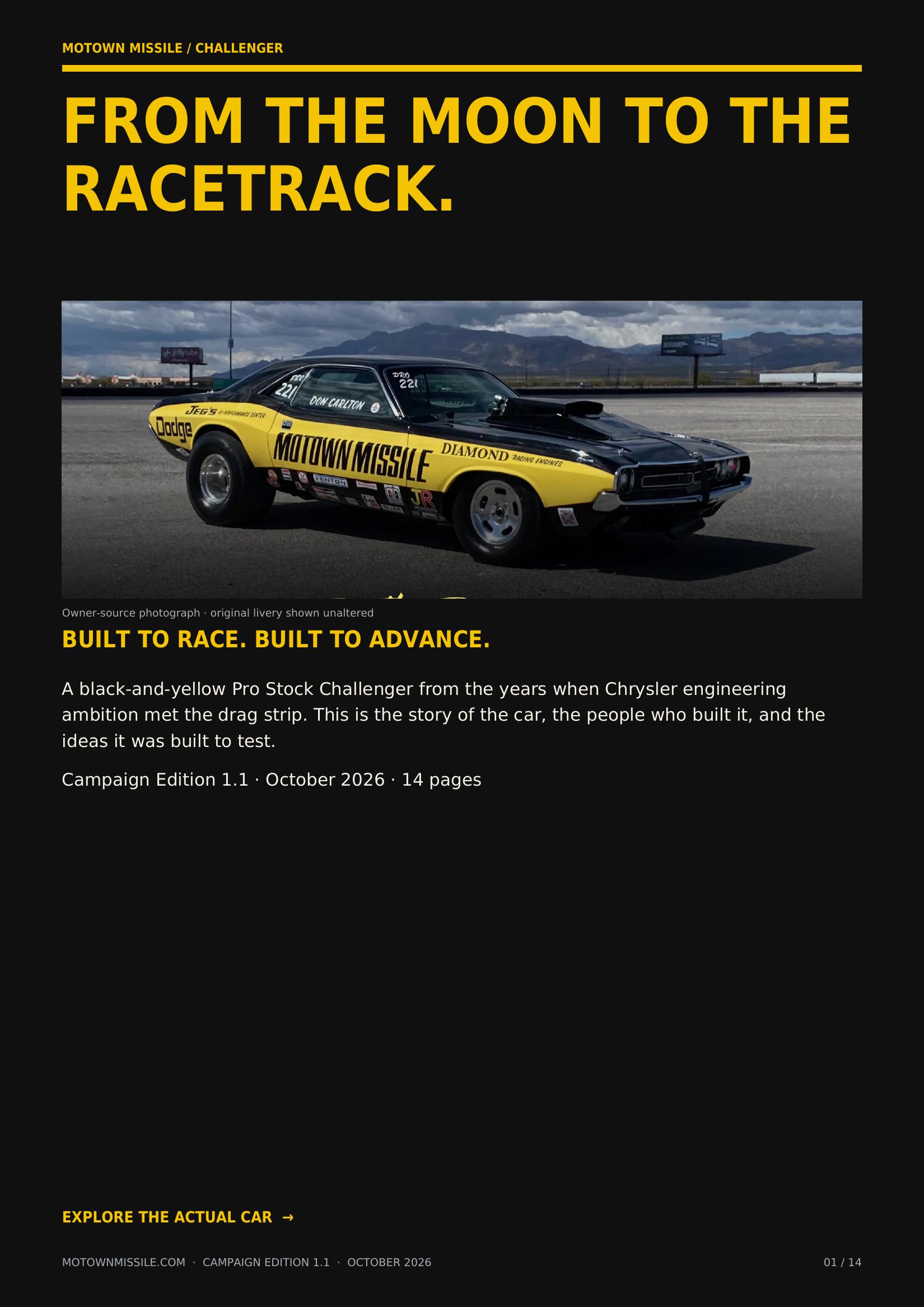
A black-and-yellow Pro Stock Challenger from the years when Chrysler engineering ambition met the drag strip. This is the story of the car, the people who built it, and the ideas it was built to test.
Campaign Edition 1.1 · October 2026 · 14 pages
Explore the actual car →2 / 14ONE CAR. ONE MISSION.
The owner’s booklet traces the Motown Missile to a factory 1970 HEMI four-speed Challenger, rebuilt into its late-1971 configuration.
It was built by Ted Spehar and his team working with Chrysler Special Vehicles engineers, as a factory Pro Stock development platform rather than a showroom car.
The body was acid-dipped and lightened. Today it wears the correct 1971 black body and broad yellow billboards, with its period patina deliberately retained.
See the car in detail →3 / 14WHAT DOES THE MOON HAVE TO DO WITH PRO STOCK?
In the 1960s, Chrysler’s Space Division developed and built the first stage of the Saturn IB rocket used on early Apollo missions.
That expertise travelled. Ron Killen, an aerospace electronics engineer from Huntsville, moved into Chrysler’s Race Division to work on data analysis for NASCAR and Pro Stock.
Period reporting in January 1972 described this Challenger as an engineering test bed, with its findings fed to other Chrysler team cars. The link is people and know-how — not rocket hardware in a race car.
Read the connection →4 / 14THE TEAM BEHIND THE MISSILE.
Tom Hoover conceived and championed the program. Ted Spehar and his team built the car. Dick Oldfield and Don Carlton drove it.
Around them, Chrysler engineers brought advanced chassis work, engine development and space-age materials to a single question: how do you make a car launch harder and run cleaner?
Ron Killen’s ignition work and the team’s data-led approach turned every pass into information.
Meet the people and sources →5 / 14426 HEMI. DUAL-PLUG.
At the heart is a 426 dual-plug HEMI, block 30. Mullens-ported heads feed from a tunnel ram, with modified Holley 1050 CFM carburetors prepared by John Bauman.
A Ramcharger oil system with a custom swing pickup kept oil where the engine needed it under hard launch. Internal parts were machine-lightened and chemically milled.
Power goes through an aluminum A-833 four-speed with a Hurst inline shifter to a Dana 60 rear axle with 5.38 gearing.
Explore the engineering →6 / 14THE SCIENCE OF THE LAUNCH.
Ron Killen’s capacitive-discharge ignition used magnetic crank triggers with split timing across dual distributors, driven by a Hilborn dual-drive unit.
Engine research aimed at measurable gains: intake resonator tuning, lower rotating inertia and friction, better compression and efficiency, less weight, and carburetion matched to air density and mass flow.
Each idea could be tried on this car before it reached others.
Inside the engine program →7 / 14EVERY RUN, RECORDED.
According to the owner’s account, the team adapted recording technology developed by Chrysler’s Space Division for NASA programs.
Multi-channel strip-chart recorders and a Data Van with its own weather station logged each pass, so the team could compare a launch against the conditions it ran in.
The result was a car that produced answers as well as times.
See the Data Van story →8 / 14WEIGHT TRANSFER, ENGINEERED.
The chassis was tuned to move weight to the rear tires at the right moment: adjustable wheelie bars, carefully set shocks, and titanium strut rods and hardware.
Up front, fascia, splitter and hood-scoop development explored how air moved over and through the car.
Historically the team also tested a clutch-launched, manually shifted B&M six-speed — an experiment distinct from the four-speed described in the car today.
Chassis and aerodynamics →9 / 14WHERE THE DRIVER WORKED.
The cockpit is a working space: shifter, gauges and controls arranged for a driver with seconds to get everything right.
The owner’s booklet presents cockpit photography by Cliff Gromer and records a signed front valance, photographed by Motown Missile Racing.
Signatures and display history are presented as the owner’s account and remain open to specialist review.
Open the gallery →10 / 14THE ADVANTAGE DID NOT STOP AT ONE CAR.
The stopwatch measured a run. The engineering effort reached further.
Period reporting describes findings from this test bed being passed to other Chrysler team cars, and Ron Killen’s firsthand account describes test reports shared among racers once ideas proved useful.
That is the car’s real significance: a place to test what came next, for more than one team.
BUILT TO RACE. BUILT TO ADVANCE.
Read the influence story →11 / 14HEY STARMAN — WANNA RACE?
The car carries its own space story. Greg of Akron’s trunk artwork shows the Motown Missile as a rocket-bodied craft streaking past a rainbow and a bright star.
That painting inspired the Vision Film’s finale, where the car becomes a craft and climbs into orbit with one line on screen: “Hey Starman—wanna race?”
Watch the finale →12 / 14LAUNCH CONTROL.
A 105-second narrated film follows the story from the Moon to the racetrack and back to the actual car. Best watched with sound on.
The astronaut, craft and space scenes are fictional brand storytelling. The car, its lettering and its livery come from real photographs.
Watch the Vision Film →13 / 14RACING HISTORY. YOUR NEXT CHAPTER.
THE NEXT CUSTODIAN AWAITS.
The current custodian, Arnie Klann, presents the car with its owner booklet, photographs and source records. These are available for review; final inclusions and transfer rights are documented in the sale agreement.
Private auction targeted for Q1 2027 — tentative. Auction partner, date and terms are awaiting confirmation.
Start with the collector briefing, then request collector access.
Begin the collector path →14 / 14READ THE RECORD.
Historical details in this edition come from the owner-supplied Proof 10 booklet and the period sources below. They describe the car’s development history; they are not an independent authentication or a current inspection. Chrysler’s aerospace work is cited for context and implies no NASA endorsement, no Saturn V hardware and no Apollo-flown parts.
Full provenance record →